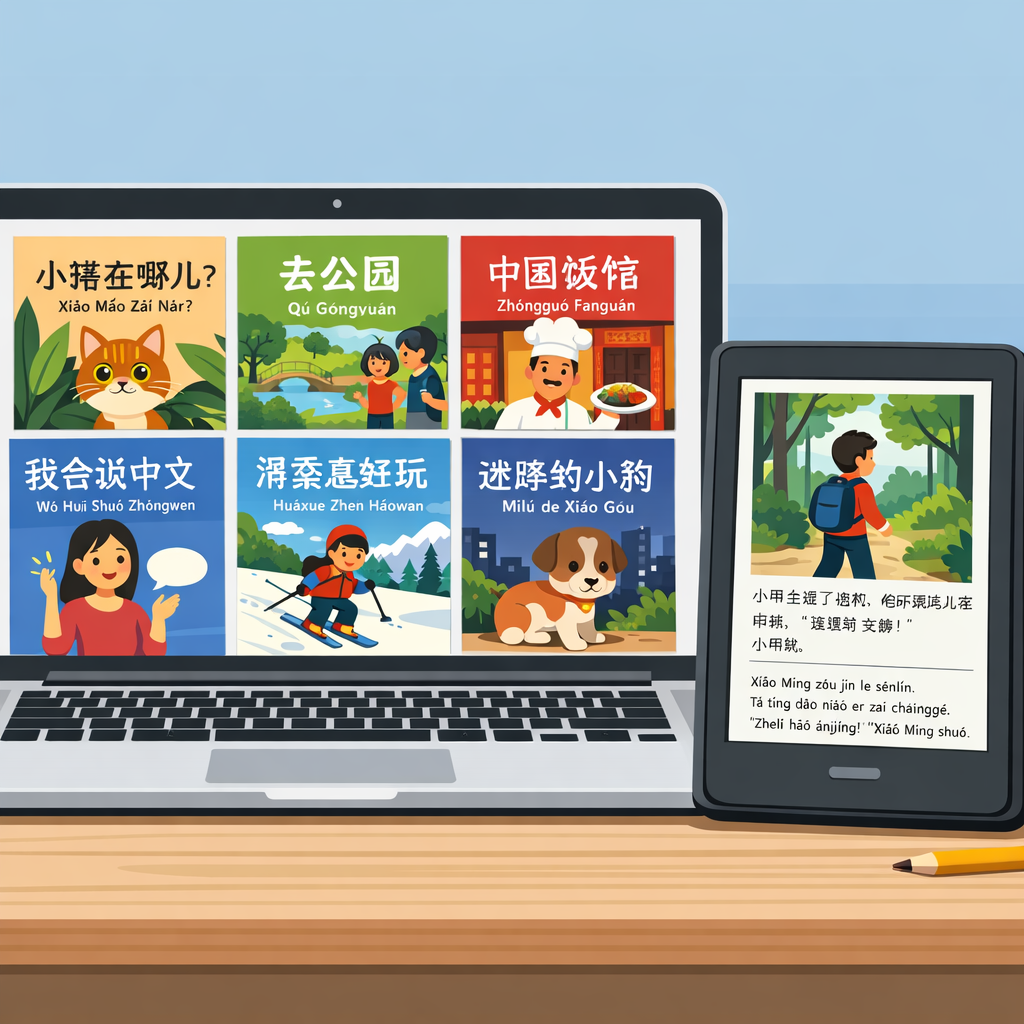
Learn how to choose the right Mandarin graded readers and ebooks for your level.
Why graded readers and ebooks are ideal for learning Chinese
If you’re an intermediate learner who wants to “learn Chinese by reading,” Mandarin graded readers and ebooks are one of the most efficient tools available. Instead of fighting through dense textbooks or jumping into native novels that are far above your level, you can enjoy stories written or adapted specifically for learners. The main challenge is knowing where to start. Different series use different vocabulary lists, character counts, and difficulty scales, and not every catalog suits every learner. Choosing wisely can save you months of frustration and help you build a library that grows with you. Begin by clarifying your current reading level. If you have taken an HSK exam or placement test, that’s a good baseline. Roughly speaking, late-beginner readers (HSK 1–2) should look for texts with very limited vocabulary and short, repetitive sentence patterns. Lower-intermediate learners (HSK 3–4) can handle longer chapters, more varied structures, and a wider range of topics. Also consider your long-term goals and interests. If you are fascinated by modern life in Mainland China, look for series set in contemporary cities using common colloquial language. If you’re drawn to Taiwanese culture, prioritize materials that use Taiwanese settings, characters, and sometimes region-specific vocabulary. The more you care about the content, the more likely you are to keep turning the digital pages.
Popular series and platforms for Mandarin graded ebooks
Once you know your level, it’s time to explore concrete options. Several publishers and platforms specialize in Chinese graded readers and ebooks, each with slightly different strengths. Mandarin Companion is one of the most popular series for learners at the late-beginner to intermediate stages. Their Level 1 and 2 books adapt classic Western stories into modern Chinese settings with strictly controlled vocabulary. You can find titles such as “Great Expectations: Part I” on their official site at Mandarin Companion, as well as through various online bookstores. These ebooks generally come with both simplified and traditional character versions and sometimes include audio. For learners who want stories rooted in Taiwanese culture, Abby’s “Easy Chinese Stories” series from Talk Taiwanese Mandarin offers graded readers focused on Taiwan-specific settings and vocabulary. Her catalog, described on Talk Taiwanese Mandarin, is especially appealing if your long-term goal involves living, working, or studying in Taiwan. Online article-style graded texts and story collections can complement your ebook library. The comprehensive guide at Dig Mandarin compares many of the major graded reader series, helping you decide which catalog is likely to fit your interests and level. You can also supplement with short online stories from sites like HSKStory and Chinese Reading Practice, treating them as “appetizers” between longer ebook chapters.
Combining graded readers with authentic materials over time
As your Chinese improves, your reading diet should become more varied. Relying only on tightly controlled graded readers can eventually slow your progress because you’re not meeting enough new language in realistic contexts. At the same time, jumping straight into unadapted novels or news can be discouraging. The solution is to gradually blend graded and authentic materials. A practical approach is to think in phases. In the early intermediate phase, aim for perhaps 70–80% graded readers and 20–30% supported authentic content, such as short, well-structured articles that include vocabulary glosses. Over time, you can reverse that ratio, using graded readers mainly for comfort reading and review, while most of your input comes from semi-authentic or fully authentic texts. Ebooks make this progression easier because you can adjust font size, highlight unknown words, and often use built-in dictionary tools. Many e-readers and apps allow you to tap on a character or word to see a definition instantly, which dramatically lowers the friction of tackling more complex texts. No matter what you read, continue to monitor comprehension. If you routinely need to look up more than one or two words per sentence, the text is probably too hard for extensive reading. Keep challenging yourself, but always ensure that the majority of your reading time is spent actually reading in Chinese—not living inside the dictionary interface. By gradually expanding your ebook library and mixing in more authentic content, you’ll build the skills and confidence to one day pick up a native Chinese novel or long-form article and simply enjoy the story, just as you would in your first language.